

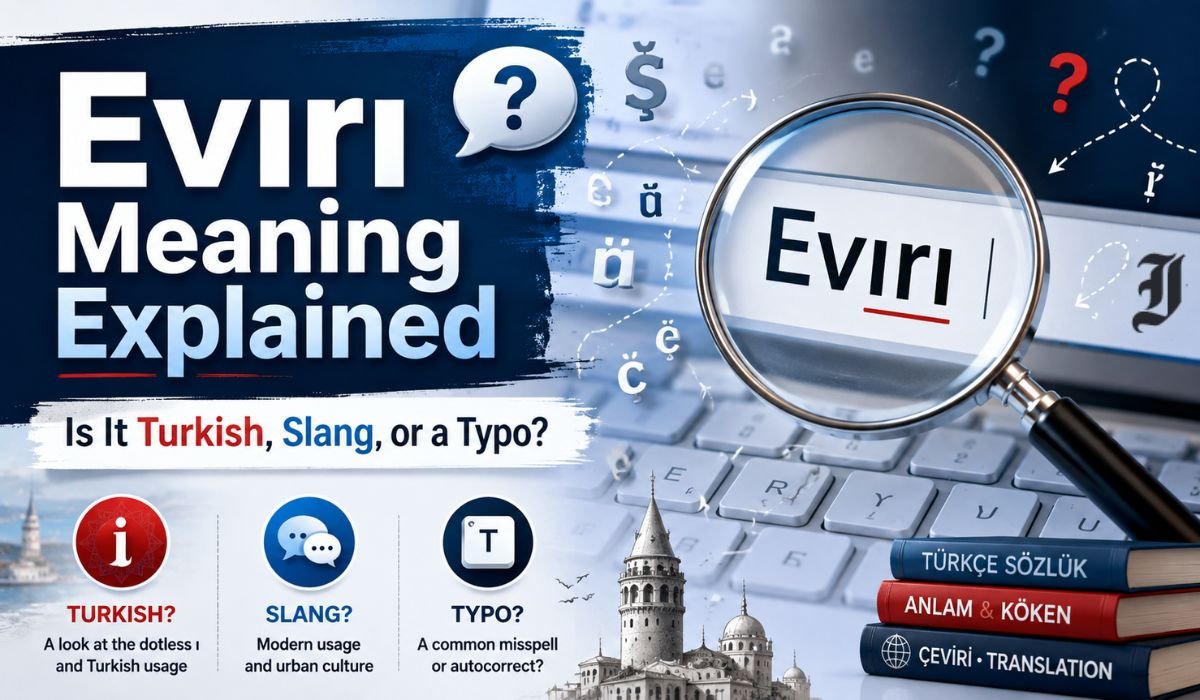
The keyword Evırı looks Turkish because it contains the dotless letter ı, a genuine character in the Turkish alphabet. That clue has encouraged websites to define Evırı as unity, harmony, belonging, or transformation. Yet those attractive meanings are not supported by a standard dictionary entry or dependable linguistic evidence. The most accurate explanation is that Evırı is a nonstandard online spelling whose intended meaning changes with context.
It is often confused with çeviri, the Turkish word for translation, and may also be influenced by evirmek, a real verb connected with turning, converting, or altering. Its story shows how typos, special characters, search engines, and repeated claims can turn an uncertain spelling into a widely searched keyword.
What Does Evırı Actually Mean?
There is no single verified English definition of Evırı. It should not automatically be translated as “togetherness,” “community,” or “complete unity,” even though several blogs use those descriptions. A safer definition is that Evırı is a searchable, nonstandard form resembling genuine Turkish words. On a page about subtitles or translation tools, it probably points toward çeviri. In content about evolution or change, it may echo evirmek or evrilmek. As a username, company, app, or product name, it may simply be a coined label defined by its creator.
Is Evırı a Real Turkish Word?
Evırı looks like Turkish, but appearance alone does not make it an established Turkish word. The Turkish Language Association, known as TDK, maintains the principal modern dictionary resources used to check standard spelling and meaning. Its records include related vocabulary such as evrilmek, defined as naturally changing from one form into another, but the exact spelling Evırı is not established as a standard headword in the evidence reviewed for this article. That does not prevent creative use, but claims describing Evırı as an ancient Anatolian saying or recognized cultural value require evidence from a dialect dictionary, historical text, or qualified linguist.
Why the Dotless “ı” Matters
The spelling Evırı contains two examples of ı, the Turkish dotless i. Turkish has 29 letters and treats dotted i/İ and dotless ı/I as different letters, not decorative versions of the same character. TDK lists eight Turkish vowels: a, e, ı, i, o, ö, u, and ü. For U.S. readers, this distinction is essential because replacing i with ı can alter both spelling and pronunciation. It also explains how unusual forms emerge when people switch keyboards, copy text between websites, or imitate Turkish spelling without knowing where special letters belong.
Three Plausible Explanations for Evırı
Rather than assigning Evırı an unsupported cultural definition, readers can evaluate three evidence-based possibilities:
- A distorted form of çeviri: This is the strongest explanation when the surrounding topic involves translation, subtitles, translated songs, dictionaries, or language tools.
- A form influenced by evirmek: The genuine Turkish verb evirmek can mean to change, convert, alter, turn, or invert, making “transformation” a possible association rather than a proven definition.
- An invented digital label: A brand, account, website, or online community may adopt Evırı as a distinctive name without it belonging to traditional Turkish vocabulary.
Evırı Versus Çeviri
The most useful comparison is Evırı vs. çeviri. Çeviri is the normal Turkish noun for translation or a translated work, and Turkish universities use it directly in course titles for Turkish-English translation. Evırı is not a correct substitute in formal Turkish. It lacks the initial ç and changes dotted i letters to dotless ı letters. A person using an English keyboard might simplify çeviri as ceviri, but Evırı involves additional changes. Search pages have grouped the forms together, encouraging readers to assume they mean the same thing. When translation is intended, çeviri is accurate.
Is “Eviri” Turkish Slang?
The dotted spelling eviri creates another layer of confusion because it is not identical to Evırı. A Turkish Wiktionary entry citing Hulki Aktunç’s Büyük Argo Sözlüğü describes eviri as slang for a false, unsuccessful, or plagiarized translation presented as new after an existing version is altered. That narrow meaning should not be transferred automatically to Evırı, since Turkish distinguishes i from ı. The key difference is simple: çeviri is the standard translation term, eviri has a documented specialized slang use, and Evırı remains an uncertain online form whose meaning must be inferred from context.
The Connection to Evirmek and Evrilmek
The strongest genuine word-family connection involves evirmek and evrilmek. Dictionary sources give evirmek senses such as turning, converting, altering, or inverting, while TDK defines evrilmek as changing naturally from one form into another. Academic work also documents the historical evirmek word family. This background may explain why some writers associate Evırı with transformation. Still, resemblance is not proof. Available sources do not establish Evırı as a standard noun or ordinary grammatical form derived from evirmek. It is accurate to say the keyword may evoke turning or transformation, but not that transformation is its confirmed dictionary meaning.
The Digital Life Story of Evırı
In biography-style terms, Evırı has lived a largely digital life. It appears to have gained visibility through search pages attempting to explain a mysterious keyword rather than through major Turkish literature, official dictionaries, or documented everyday speech. Some articles linked it to çeviri and translation; others expanded it into stories about hospitality, folk traditions, unity, and personal change. As those explanations were repeated, the keyword began to look established. This shows how online repetition creates perceived authority: several pages may seem independent even when they repeat the same unsupported assumption.
Why “Unity” Claims Should Be Questioned
Definitions such as “complete togetherness” or “the spirit of Turkish community” are emotionally appealing, but the pages promoting them generally do not identify a TDK entry, historical manuscript, regional-language survey, or recognized linguist. Some admit that Evırı is absent from standard dictionaries while also claiming ancient rural roots. A dialect word can be missing from a general dictionary, but proving regional use requires documented examples. Turkish hospitality and community values do not verify Evırı as their name. Until stronger evidence appears, unity-related meanings should be labeled modern interpretation or speculation.
Is Evırı Internet Slang?
Evırı can reasonably be called an internet keyword, but “established internet slang” is a stronger claim than the evidence supports. Slang normally develops through visible community use in conversations, captions, memes, or messages where participants share an understood meaning. Most searchable uses of Evırı are articles asking what it means, not natural exchanges showing that speakers already know the term. That pattern suggests search-driven content rather than living slang. It may become an online expression if users adopt one meaning, but “nonstandard term,” “search variation,” or “invented label” is currently more precise.
How Is Evırı Pronounced?
Because Evırı is not a verified standard word, it has no authoritative dictionary pronunciation. If read strictly according to Turkish spelling, both dotless ı letters would use the Turkish back unrounded vowel, a sound with no exact English equivalent. Online guides sometimes approximate the word as “eh-vuh-ruh,” but that is only a rough aid. The intended pronunciation may differ when Evırı is a brand, username, or invented term. A careful article should explain the likely Turkish-style reading without calling it official.
How U.S. Readers and Writers Should Use Evırı
Context offers the best guide. Near phrases such as Turkish translation, English subtitles, language converter, or translated lyrics, Evırı is probably a mistaken variation of çeviri. Near words such as evolution, turning, or transformation, it may be influenced by evirmek or evrilmek. In a logo, app name, social handle, or domain, treat it as a proper name until the owner defines it. Writers targeting the keyword can remain SEO-friendly by naturally using related phrases such as “Evırı meaning,” “is Evırı Turkish,” “Evırı vs. çeviri,” “Turkish dotless i,” and “evirmek meaning,” while clearly separating verified language facts from online speculation.
Final Thoughts
Evırı is best understood as a case study in digital language rather than a firmly defined Turkish cultural word. Its special characters are genuinely Turkish, and its resemblance to authentic words is meaningful, but the exact form lacks a verified standard definition. In translation contexts, çeviri is the correct word. For turning, conversion, or transformation, evirmek and evrilmek are established terms. The dotted form eviri also has a separate, specialized slang meaning related to questionable translation. Unless stronger linguistic evidence emerges, the most responsible conclusion is that Evırı is probably a typo, stylized spelling, or invented online expression—not proven traditional Turkish slang.
Frequently Asked Questions About Evırı
1. What does Evırı mean in English?
Evırı has no single verified English meaning. It may refer indirectly to translation, transformation, or a private meaning assigned by a brand or creator.
2. Is Evırı an official Turkish word?
The exact spelling is not established as a standard Turkish dictionary headword in the evidence reviewed. It should be described as nonstandard unless a specialist source proves otherwise.
3. Does Evırı mean translation?
Not in standard Turkish. Çeviri is the correct Turkish word for translation, although Evırı is sometimes used online as a confused variation.
4. Does Evırı mean unity or togetherness?
No authoritative linguistic evidence confirms those definitions. They appear mainly in recent online articles and should be treated as speculative interpretations.
5. Is Evırı Turkish slang?
It is more accurately described as a nonstandard internet keyword. The similar dotted form eviri has a documented narrow slang sense, but the two spellings are different.
6. What is the difference between Evırı and eviri?
Evırı uses dotless ı, while eviri uses dotted i. Turkish treats these as separate letters, so the words should not automatically be considered identical.
7. What is the difference between Evırı and çeviri?
Çeviri is the established Turkish term for translation. Evırı lacks the initial ç and uses different vowels, making it a nonstandard form.
8. Is Evırı connected to evirmek?
It may be influenced by evirmek because the forms look similar and evirmek relates to turning or converting. No reliable source confirms Evırı as a standard derivative.
9. How do you pronounce Evırı?
There is no official pronunciation. A Turkish-style reading would use the dotless ı sound, but a creator or brand may intend another pronunciation.
10. Should Evırı be used in formal writing?
Use it when discussing the keyword itself or reproducing a proper name. For translation or transformation, choose the correct established Turkish word for the context.